I've been super busy working on my project to condense down my old tutorial videos into more digestible and concise videos. I know table tennis fans usually want to get to the core of a lesson quickly and are eager to get off and practice! Here are some of the newest videos:
As part of my ongoing efforts to be more active teaching online via YouTube, I have started another new segment of videos called 2 minute tips. This segment will be focused around small pieces of advice, focus areas, and things to think about on your journey through table tennis development into a better player.
My first tip below is about achieving better depth placement on your first opening loops, and the difference going into a rally that this can have against your opponent.
Hope this is something concise and useful for you to think about, hoping to get many more small tips out there as time goes on!
Hi everyone! I've started working on something I have been meaning to do for quite a while, and that's condensing some of my older tutorial videos into shorter, more digestible ones.
As you may remember my tutorials involved a lot more explanation and details, but this is not for everyone. In an age where attention spans are getting shorter, I decided to pick some of my best tutorials and re-edit them to create new 4-minute edits - where the videos are 4 minutes or less.
Hope you enjoy, the first two center on my 3-step reverse pendulum serve tutorial, and my basic backspin serve tutorial!
I'll be looking to do about 15-20 of these edits, so hopefully they are useful for some of you! :)
Wanted to share this video blog I made about my time teaching legendary EDM DJ Steve Aoki table tennis at his own personal PingPod at his house in Las Vegas.
Teaching Steve Aoki Table Tennis
I went along one night with US Olympians Kanak Jha and Amy Wang, and then spent the next two evenings teaching Steve more about the foundation skills of table tennis. He's a super fast learner and I really enjoyed the opportunity, check it out:
Episode 10 of Talkin' Smash is here! It's a little bit of a longer episode, because well...we can't help ourselves when it comes to talking about table tennis!
Max Kogler, CEO of PingPod, joined me to talk about bridging the gap between social and pro table tennis. We talked about the conception to construction phases of PingPod, and how their digital, coaching and technology strategies are helping make table tennis more accessible.
In Episode 10 I was joined by PingPod CEO Max Kogler to talk about bridging the gap between social and pro table tennis!
Learning more about PingPod was very interesting for me. Obviously it has become a prominent fixture on the east coast of the USA, now having grown to 17-18 locations (including one in the Philippines and one in Bristol at TTDaily).
Max went through all of the incredible technology behind PingPod and how it is designed to make table tennis more accessible. PingPod are putting locations in more city locations and taking table tennis to the people. They are working to remove some of the exclusivity from elite training academies that can sometimes intimidate or deter social players from joining the sport. This is what has contributed to creating a big gap between an enormous social/recreational ping pong audience, and the professional table tennis scene.
I had a great time talking to Max, including putting him under the gun with my classic break segment, which produced some phenomenal results ;)
I had the pleasure of sitting down with long-time JOOLA Athlete and Brazilian Olympic Table Tennis player, Thiago Monteiro. He was coaching at the Pan Am Cup in Texas, so it was a great opportunity to fly him out and have him with us here at JOOLA HQ in Rockville, MD!
Thiago Monteiro joined me to talk about his career and legacy in table tennis - Talkin' Smash Episode 9!
Thiago spoke about his career from the early beginnings, and I was particularly interested to hear about how he made the decision to move to Europe. At the time there weren't really any role models to follow. Hugo Hoyama was travelling to Europe but still living in Brazil. Monteiro made a bold move, one which would result in him spending his 20+ year career living in France and competing in leagues across Europe.
I also asked Thiago about how he thought about his influence on the generations of players which came after him, and the legacy he has left in the sport for both Brazilian and Latin American players as a whole.
To kick off Talkin' Smash in 2024, there's no better guest than Dan Ives. Dan is a great friend of mine and we have been moving independently in the same circles for many, many years as content creators and people who are extremely passionate about table tennis. I joined TableTennisDaily quite early on and was also the Facebook Page Admin for a small stint in the very beginning. Time has flown for both of us.
Talkin' Smash Episode 8 with Dan Ives from TableTennisDaily
From those early days the brand now boasts it's own team series in the British League, an organized 8-team Super League competition, a refurbished HQ building which is now Europe's first PingPod - as well as multiple masterclasses in it's academy with top professional players.
Ives created TableTennisDaily over 12 years ago, starting out as a YouTube channel and a small forum for the most die hard table tennis fans. Over the past decade TableTennisDaily has grown into a powerhouse in the sport.
It was fun to catch up and hear about how the TableTennisDaily brand has evolved over that time, the inspirations, the challenges, and a look into the mind of the man behind it all - Dan Ives.
Episode 7 of the Talkin' Smash Table Tennis Podcast powered by JOOLA, was another specialized topic - one I hope may help those out there suffering from table tennis or sports-related injuries and trying to find ways to improve their situation. I sat down and spoke with Sophia Klee, a rising star in German and European women's table tennis.
A pleasure to be joined by Sophia Klee to talk about coming back from an injury in professional sport
Sophia had a great start to her playing career, with incredible success in the European Cadet age group. She was, in 2017, champion of the Cadet Girls Singles at the European Youth Top 10 Championships, and in the same year won the Cadet Girls Doubles at the European Youth Championships.
Her career sat on a knife-edge however at the beginning of 2022 when she suffered an unusual injury - breaking her knee cap during a table tennis match.
While she managed to avoid having surgery, the road back was still one which presented challenges both physical and mental. It was great to chat with Sophia about her road back, and how she pushed herself back to the game she loves and continued on her journey to the top!
I was at the JOOLA North American Team Championships a couple of weeks ago, a perfect opportunity to get my friend Ryan Willard to sit down face to face with me this time. We sat together on the main tournament court with hundreds of players around us, competing on 167 tables. It was the perfect environment to talk about the atmosphere of live table tennis events.
Ryan Willard joined me to talk about the haves and have nots of live table tennis events!
This is a topic I have gripes with. I think digitally table tennis presentation has improved a lot, the investment into cameras and production, particularly at the international level, has made a big difference. That being said, the majority of events still fail to fill seats. This is a huge challenge for event organizers who are trying their best to promote the sport and do new things, but also for the professional sport as a whole.
Why do hundreds of people show up to watch sports like pickleball, cornhole, darts, snooker etc? Are those sports on a totally higher level than table tennis? I don't think so.
Table Tennis is complex, it's hard for the average viewer to understand and comprehend. When a player does a filthy reverse pendulum serve and it gets dumped in the net - for a table tennis player this is a moment of appreciation for a great serve. For a mainstream spectator however it's lame, all they see is a serve receive error.
There are certainly many angles to cover on this topic, I was glad to chat to Ryan about a few of those in this podcast. Be sure to check it out below on YouTube. Follow on Spotify or Apple too for your gym sessions or commute to or from work!
It was great to have Lily Zhang back on the podcast. She is a fun guest, but also a 3-time US Olympian and a 6-time US National Champion! Lily and I spoke about Overcoming Challenging in Serve Receive. It was a fitting follow-up to the previous episode where Craig Bryant and I spoke about Serve Practice Habits!
Talkin' Serve Receive with Lily Zhang
This year Lily had written some more blog posts about her experiences in specific WTT events or matches. One of the ones which stood out was her blog about competing in a match against Japan's Mima Ito and Taking on the World's Best at WTT Singapore Smash!
Serve Receive was such a prominent factor in this match, it made sense to delve into this topic with Lily and get her thoughts on the subject more.
Already bouncing around some different topics and I have been doing my best to get the best possible guests to match with specialist topics. That being said, this Episode 4 Podcast was also a perfect match. Talkin' Service! with Craig Bryant. No better man for the job than @thettserviceguy (on Instagram).
My guest for Episode 4 is Craig Bryant, a service master instructor!
Craig is a former England international and a reputable coach. His 4 Killer Serves to Destroy Your Opponents YouTube video with Tom Lodziak was a hit for the online table tennis crowd. The video garnered an impressive 8.7 million views.
Now Craig is focused on building his platform and new Coaching Website as well as his social media platforms where he shares plenty of tips, tricks and fun content about the incredible art of table tennis serve.
In this episode we talk about the importance of the serve and how much simple improvements can impact a match overall. We also talk about things that frustrate us both when we see people practicing their serves, and also people teaching serves and guiding people in serve practice.
Overall a great podcast, we got down and nerdy on a bunch of different things and it was really fun!
We are getting some air under our wings with the new Talkin' Smash Podcast powered by JOOLA. In Episode 3, my guest is Kevin Finn - the founder and trainer behind Peak Performance Table Tennis. Kevin is a certified Strength and Conditioning coach and a published Author. We chat about physical training in table tennis, some of the misconceptions and what good habits to build and consider.
Kevin Finn is my guest on Episode 3 of Talkin' Smash!
Kevin's book Peak Performance Table Tennis - Unlock Your Potential and Play Like the Pros was released in November 2021, and his popularity in the field has continued to grow. Through his online platforms and social media he works with table tennis players to test his physical training programs and exercises through focus groups. This allows him to continuously fine-tune his training plans.
From conversations on the falsely taboo muscle building in table tennis, to making the most of your physical training time by choosing the right workouts - Kevin offers a very specific knowledge in this field, especially with his own table tennis background to add into the mix.
In episode 2 of the Talkin' Smash Podcast powered by JOOLA, I was joined by three-time US Olympian and six-time US National Table Tennis Champion Lily Zhang. We had a great discussion about different periods of Lily's playing career, living in different places and the pros and cons of living abroad vs. living at home in America.
Lily Zhang joins Matt Hetherington on Episode 2 of the Talkin' Smash Podcast powered by JOOLA
Zhang's career, post-university graduation, saw her experience an array of different training experiences. For the first year away from home she bounced around different countries in Europe, training and competing without a base. In year two she settled and trained full time in Dusseldorf at the German National Training Center. Her next experience saw her live in China for almost a year, during the height of the pandemic - training among the world's best with the Chinese National Team and playing in the Chinese Super League.
After these long winded and varying pathways, her journey has now brought her home to the United States - where she is based and travels regularly for overseas leagues and international tournaments.
It was great to get Lily's insights into these totally different worlds, but more so to delve into the mental challenges of each. My goal was to speak more about the challenges which players don't think about when they endeavour to move overseas and away from home full time. Lily's knowledge and learnings in these areas, especially with her graduate background in psychology - make for a unique and interesting podcast discussion.
In the first ever episode of the Talkin' Smash Podcast powered by JOOLA, I'm joined by one of my friends and a recognizable face in US Table Tennis - Ryan Willard.
Commonly seen as an MC/Host and one of my favourite co-commentators, Ryan's journey in the sport spans from being first exposed to the sport at SPiN New York, all the way to hosting the World Table Tennis Championships.
Honestly being a part of this journey with Ryan has been pretty amazing. He was literally hosting a social/pro competitive table tennis night at SPiN in New York City, and gradually over the years brought something special to the game. It has been my pleasure to work with him over many years now, and to see him go from the shadows of SPiN to the lights of the biggest table tennis events in the US and the World!
Ryan was without a doubt the perfect person to start off my new podcast with, as a seasoned podcaster himself, and also as someone who brings an entire spectrum of experience in our sport - all the way from being fresh to the game, to having seen it at its very best.
You can also check out the audio podcast on Spotify!
I know it's been a long time since I have posted here on my blog, hopefully most of you have been able to keep up with me on my Instagram @mhtabletennis where I have been posting everyday!
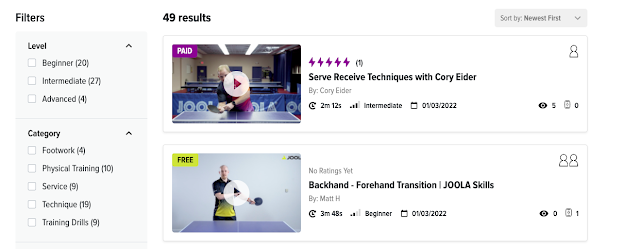
Recently, since beginning to work with JOOLA Global, I have been producing coaching videos for the new JOOLA Infinity App. I'm really excited to be part of this project and be able to spend some time finally delving into sharing some more special tips on techniques, experiences and tactics as well as training drills and more!
The app already has dozens of videos, with a good balance of free and premium content. Currently there are a handful of coaches, one being my own Physical Trainer Kevin Finn from PeakPerformance Table Tennis, and another being 3-time Olympian Lily Zhang.
There are a handful of new videos released to the platform each week, and the number of coaches and content types will only continue to expand as the app grows!
To kick things off, I am uploading weekly videos from my 11-part Basics for Beginners series of videos from the app, you can check out the first one below on the basic racket grip. Many of you will be too advanced in your game for these, but perhaps you can share them with friends who are looking to get into the game!
This is the perfect chance for anyone from a basement ping pong player, to an aspiring table tennis player, to learn something to enhance their game.
I hope you will all join the app and join me as I continue to work hard putting out more videos!
Still in the process of getting all of my videos summarized and up here on the blog, I'm hoping to get more productive moving forward. I know I keep saying it, but this time cross your fingers and hopefully it will be true :)
In this article I will do a quick four point summary of my tutorial video on the long fast serve!
4 Key Factors for High Quality Long Fast Table Tennis Serves
See below, the video tutorial which covers the 4 points, you can also read the summary points I have written below - the video is 13 minutes long in more of a detailed style, so if you don't have time now, perhaps save it for later! :)
1. Serve Depth
An effective long-fast serve needs to consistently be deep on the table, this means getting as close to the back edge, side edge or corners as possible. A good exercise for this is to put a towel on the table or a marker and ensure that you can consistently serve inside a deeper 'zone' on the table.
2. Serve Speed
In order to make your long fast serves most effective, they need to have a quick and low trajectory. A long serve which lacks speed is not going to be useful in matches. A good way to practice this is to put a slightly weighted object (usually empty boxes are good) on the end of the table, and practice serving fast to try and knock the item back towards and off the table edge.
3. Serve Actions
It is important that you are able to reduce any tells with your service actions. Long fast serves need to be a surprise to your opponent in order to have maximum effect. You should practice connecting short, half-long and long serves with similar actions - in order to disguise them. You can practice serving in pairs of short/long with the same/similar actions.
4. Serve Precision
Putting a ball on the table or some kind of small target can help increase your serve accuracy. As your table tennis opponents get more high level, it is important to be able to target specific places on the table. Knowing how to adjust your weight transfer, direction and contact in order to achieve a pinpoint placement is vital, and so using small targets as demonstrated in the video can be useful.
These are all things that can also add to making your serve practice more engaging and purposeful. If you are trying to improve your long fast serves, perhaps some of this information can be useful to you!
Thanks for reading, and if you haven't already be sure to subscribe to my YouTube channel and help share some of the videos to get them to others who may find them useful too!
I decided it would be a great time to upload all of my coaching tutorial videos to the blog, this might take a while, but now that people are returning steadily to the table it seems like a good time to refresh people's memories!
This was a great set of 4 simple tips for mastering the ghost serve, along with some handy advice and demonstration from England's Sam Walker, a Commonwealth Games quarterfinalist, World Team Championship and World Team Cup bronze medalist!
Master the Ghost Serve with MHTableTennis and Sam Walker
Hope you enjoy the video below, please note these videos are a little longer and more detailed. Hopefully they help you learn this great serve, and also improve your backspin contact in the long term!
I'm on a mission to create 30 coaching tutorial videos in the next 30 days. I started off days 1 and 2 with tutorials on the basic forehand and backhand loop techniques against backspin. Tomorrow I will release a tutorial on the backhand banana flick.
The current situation has left me with no work for the past 2 months, meaning covering my health insurance and medical costs is a new challenge. In an effort to support myself I have opened up an optional donation/contribution platform for anyone who finds these videos useful for their game and may wish to show their support.
Well overdue for some blog post additions to my coaching blog, and here is one I hold in very high regard. People often ask what it takes to become a top table tennis player, well that line says it all in itself. I like to separate the term player and athlete, because I believe there are key differences in how people approach these and their attitudes and mentality. I will explain.
The steps to become a table tennis 'athlete'
and a potential professional


.png)