Thursday, 12 June 2014

Building Depth Footwork Skills

Alexandra Dimitrova has asked a great question, 'Can you recommend a good footwork drill for long and short play?' adding that the focus always seems to be on lateral movements and not so much on movement in and out of the table. Thanks for a great question Alexandra, as it happens I have a few great drills for this kind of footwork development! :) See more from my Coaching Blog.

Building Depth Footwork Skills
First of all let's discuss why depth footwork is important. Well for a start table tennis has evolved to such a state that most points begin with shortplay and a constant psychological and tactical battle of finding a chance to attack first and shutting down your opponents chance to do so. This means the emphasis on short serve and receiving has grown over the last decade and the points have become a lot tighter.

With the speed of the game, a ball placement can quite quickly transform from shortplay to a first attack, so there is a strong need to develop in and out footwork and to be able to execute it with speed. Often you may need to come in and short push a short serve and immediately recover to counter a flick or long push or some other scenario along those lines.

Topspin Depth Drill: This drill is used to combat varying pace in a topspin rally. One player simply controls the ball by blocking a ball soft and shallow, the attacking player must stay close to the table as the ball drops medium length. The blocker then blocks the next ball with a bit more pace and good long depth, the attacker has to move back to accommodate the deeper bounce. This alternates with the blocker placing the ball soft and shallow, faster and deep and the attacker is moving in and out alternately to match. You can vary this drill by allowing the blocker to randomise the pace of their blocking also.

Short Receive and Recover to Topspin: This drill is a reaction recovery and involves moving in and out with speed. The drilling player receives a short backspin serve by moving in and pushing the ball short, the server then flicks the ball (can be to a fixed point or random). The drilling player must recover quickly in order to attack or counter the flicked ball. This is a very important depth drill as it is becoming a more and more common scenario. The faster you can recover the more pressure you can put on your opponent, a slow recovery will not give you much time to attack and your receive of the flick may be passive. A fast recovery gives you time to be in position and execute more weight transfer and time to make strong placements. You can start practicing by recovering to block or small counter the flick then build into a fast recovery and a full counter or looping play on the flicked ball.

Short Receive and Recover to Underspin: This is similar to the above, you move in and short push off a backspin serve, the server then pushes long (most effective is to the backhand corner or body), to get the best speed development you should aim to open with a forehand loop no matter where the ball is on the table. This requires a fast recovery in order to execute the weight transfer necessary to produce enough topspin on the long push ball. This is a highly recommended drill for 3rd and 5th ball attacking players.

Flick Receive and Counter: This builds an even higher paced drill and allows you to deal with an offensive play from in-table. The server can essentially serve any spin short, you will move in and flip the ball. The server will then attack the ball you have just flipped. Once again you can start by recovering to block the ball and build up your footwork speed to counterattacking.

These drills form a good core to build the skills of depth footwork. There aren't many scenarios where you would have to go from out of the table in with the exception of dropshots on lobs or chopblocks on range loops so it is best to focus more on playing short then moving out to cover a long ball.

My favourite multiball drill for this skill was a short push wide on the forehand and a pivot loop from the backhand corner, this is possibly the biggest stretch in footwork you can achieve both in terms of depth and lateral movements.

Hope this answers your question well Alexandra and good look working on your depth footwork! :)

Thursday, 5 June 2014

Tactics for Playing Backhand Dominant Players

A fresh question from Paul Shih, 'What type of strategies can be used against backhand dominant players?'. Great question, it's not often we come across these types of players as the forehand is so heavily favoured in table tennis so it pays to have an idea of what to do should you stumble across a strong backhand player. Here are some strategy ideas for playing backhand oriented players. See more from my Coaching Blog.

Find the Forehand: First piece of advice is to target the weaker stroke. Often on serve receive these backhand oriented players will flip across a wide proportion of the table with their backhand. These players usually have weaker forehand serve receives. This is a common tactic you would also use against players with pips on their backhand also. You need to find the point at which your opponent will receive with their forehand. Once you know that point, you can either drag your opponent all the way across to play a backhand on one side of the point and open up space on the table, or you can target their weaker forehand receive on the forehand side of the point.

Tactics for Playing Backhand Dominant Players
Target the Forehand: A seemingly obvious tactic here, if the backhand is much stronger, then target the forehand. You also need to understand more about the strengths and weaknesses of the strokes. Your opponent may be weaker at opening with the forehand but strong in a rally, hence you would put extra pressure on service and receive to the forehand in order to force errors on the forehand ball. This is important because a stronger backhand doesn't necessarily mean a weak forehand, it's all comparative.

Where is the Strength in the Backhand: Is your opponent strong across the whole backhand side? Do they play backhands across the middle of the table? Are they effective at covering their whole backhand half, how strong are they on the wide backhand? Remember a player can be strong within their comfort zone, test the limits. A backhand oriented player must always position themselves behind the ball for a stable, well controlled stroke, this means they have to be fast and always in the right place. Test wide balls and body shots and see how effectively your opponent deals with them.

Tighten Up Shots to the Backhand: When playing to the backhand, make sure you play high quality strokes. Take away as much comfort as you can. Play long pushes with heavy spin, short pushes short and low to prevent full attacking strokes. Loop with good depth and good spin and play with lots of variation so as the opponent cannot build rhythm.

Open The Forehand Corner: The wide forehand needs to be a big target in this scenario. Not only does it target a big movement to play the opponent's weaker stroke, but it opens up a large distance to recover and guard the space created on the backhand. Forcing the opposition into the corner or off the table on their backhand side will open up more space across the forehand. If you can exploit that and play wide to the forehand, the opponent will have a large space to cover. If their weight is not balanced when they arrive at that forehand shot, they may keep moving out on their forehand side after their stroke, opening up even more space on their backhand.

These are only small tips, each player is different and a backhand player could be dominant or weak in a multitude of different areas of the game. The main tactics really are to target away from the backhand in order to create a situation where the backhand cannot be covered, at which point you have opened up a defensive gap and can exploit it to win points.

Tuesday, 3 June 2014

Tips for Effective Service Receiving

The next question wasn't far away, hopefully you find my last article on 'How to Deal with Heavy Topspin Opponents' useful! The next question was from Arjun Sreekumar who asked for some advice on receiving various services effectively. Serves come in many different forms and variations so it's quite a broad topic to cover but hopefully I can give you some useful advice on how best to deal with returning serves. See more from my Coaching Blog.

Tips for Effective Service Receiving

Learn to Read The Ball Contact: Reading service will ultimately provide you with the best idea of how to return the ball most effectively. Watching the moment of ball contact and the opponent's service action will give you a lot of information as to what they are serving. Also remember the first bounce on the table will give you information on the length of the serve, more often than not a bounce closer to the net is characteristic of a short serve and closer to the server, a longer serve.

Also pay special note as to how much contact the opponent makes on the ball, you can observe their brushing action on the ball, or the 'dwell time' which indicates the amount of spin on the ball. Including service receive against different service types in training is very important as it is one of the 4 key skills to master in order to become a well rounded player and to win matches.

Be Decisive: Hesitance is often your worst enemy when it comes to service receive. Table Tennis can be a very touchy game, alongside it's high speed reputation. Spin is difficult to control and often a soft or uncertain return of service will play right into the hands of your opponent. The best thing to do when receiving serve is to make an assertive stroke once you have decided how to receive serve. Even if it is not the correct shot selection, your chances are much better of making a quality receive of serve if you are making a shot with full confidence. This also includes having decisive placement, this is a crucial part of your return as a well placed and high quality receive can be devastating to your opponent.

Be Assertive: In table tennis the first attacker usually holds an advantage. Taking the initiative where opportunities lie is a crucial step in taking control of a point. When returning serve it is important not to be too passive when the chance arises to make an offensive play. Often we see players tripping up over medium long serves and pushing the ball back long (as a medium long serve can be difficult to play short), this gives their opponent the first chance to attack. In reality if a serve will only bounce once, it is important to develop the mentality to make an attacking stroke. This often requires a player to have an attacking mindset. Be assertive, recognise each and every chance to take the initiative.

Avoid Big Stroke Actions: Service receive is often well controlled with concise strokes. A large swing can be inaccurate or ineffective. Keeping shorter and more controlled strokes is often a better option for efficiently returning most serves. This minimises the level of risk involved, this is important as service receive is your first foot in the door into a point.

Hopefully these key pointers are enough for you to work with and focus on for increasing the effectiveness of your service receiving, even though it was quite a brief outline of the large topic of service receive. Thanks for your question Arjun! :)

Monday, 2 June 2014

How to Deal With Heavy Topspin Opponents

I decided to get some more input from the dedicated readers out there so I will now be writing posts to help solve your worldly table tennis dilemmas! The first question submitted was from Ruth Woodhams, "How do you deal with heavy topspinners?" So my first 'response' post will answer just that, thanks for your question Ruth! :) See more from my Coaching Blog.

How to Deal with Heavy Topspin Opponents
There are a few approaches, we can split it into 2 big tactics. You can either prevent the problem, or learn to deal with it.

Prevention:

If heavy topspin balls are out of your comfort zone, your first step is to try and stop your opponent from being able to make that play. There are a number of options there (combinations of the three are ideal):

Play Heavy Backspin: Make the opening ball as difficult as possible, the heavier and deeper on the table you can play the better. If they want to play heavy topspin then make it as difficult as possible for them, if you do this effectively then you may cause some of those opening balls to land in the net.

Play No Spin: A heavy topspin opponent is usually generating a lot of topspin to counter heavy backspin. So what if there is no spin on the ball? The ball will be high or go over the end of the table. Mixing heavy spin and no spin can help work against a heavy topspin player, especially if they struggle to read the oncoming ball. Even half long no spin serves can be effective especially when they break the side of the table.

Place the Ball Strongly: Heavy topspin often relies on good weight transfer from the legs, which means good balance is necessary and a solid base and centre of gravity to work with. Strong placement can take your opponent out of position, aim to make them less comfortable, play to the body or wide or into space on the table. If they aren't able to keep stable then generating spin and power becomes more challenging.

Open First: Making the first attack often presents a good advantage for any player. If you are calling the shots then your opponent has a little more added pressure on them. If you open with good topspin then it may force your opponent to use more defensive or passive options.

Dealing with Heavy Topspin:

Heavy topspin can cause a lot of trouble for a lot of players, that's why table tennis is so difficult, it's high speed and lots of ball rotations per minute. So how can you deal with the spin?

Angle Adjustment: Learning to read a ball and adjust to it can be a long process and requires a lot of practice. Whether blocking or countering a heavy topspin ball it is important to close the bat angle to cover the ball more. An open angle will fail to control a high amount of topspin. The best way to improve is to practice against the technique more, so practice more against heavy topspin balls, some fast, some slow, because pace also affects your options and reaction.

Don't Overplay: Often heavy topspin balls can cause errors when the receiving player overplays their stroke. Topspin actually gives you something to work with. When blocking ensure your weight creates a stable base and have a firm grip on your bat and a closed angle to cover the spin. Players sometimes feel the need to punch at or drive through their blocking strokes when dealing with heavier topspin balls, while this can work sometimes it increases the risk level of the return and can cause a loss of control. This is the same with countering shots, be careful not to overswing or apply too much power to the ball.

Counterloop: Precise timing can result in very effective counterloop shots. You can play the ball early in the bounce which requires a strong idea of the required timing and angle, or you can counterloop top or later in the bounce and play a loop to loop style instead. Both have their merits. Again important not to overplay strokes here.

So I hope that has given you some more ideas on how to deal with heavy topspin opponents and I hope the answer was satisfactory Ruth! :)

Wednesday, 14 May 2014

Auto-Immune Disorders and Sport: How to Keep Moving

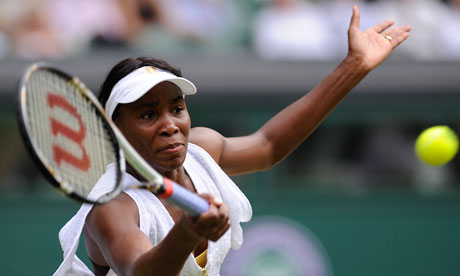
Well this is definitely out of the realms of the normal topics for my blog but I felt it was important to write something on it. At the beginning of last year I found myself at the mercy of just this, an auto-immune disease. There are over 60 different variations where the body's immune system malfunctions and begins to attack healthy cells in the body. The impact on an athlete can be catastrophic. Athletes like Venus Williams and in table tennis context, Joo Se Hyuk, are sufferers of immune diseases.

Venus Williams suffers from an Auto-Immune Disorder
Image from The Guardian

As you all know I'm a table tennis player. I have played since I was 8 years old and as such at the age of 22 when this awful disease struck me, I had already played table tennis for over half my life and had made a lot of sacrifices and commitments to continue playing. I was initially sick for 2 months and lost over 25lbs in the second month after being misdiagnosed once already. The effect on my energy levels is probably more evident than anything else. Now I'm just a week away from my 24th birthday and I've started to get a better handle on my health problems.

Sometimes it is too easy for me to think that it may be too hard to keep competing, but as with everything in life some days are bad and some are good. The bad days I have very little energy or I'm ill or with fever, these are the difficult days, the ones where I start severely doubting whether playing sport is a viable option for me. It is on these days that I need to remember what I have given up to be here, and that the only real defeat is letting myself fade away to this horrible inconvenience of an illness.

Thankfully over the past year I have learnt more about managing my symptoms and my energy fluctuations are much less sporadic than they were in the beginning, this helps me sustain longer periods of training and up until recently I had pretty good energy levels for the past few months aside from a few off days. Unfortunately for the last 3 weeks I was sick again and that kind of spurred me on to write this. As with any sport, we develop character. Strong athletes have a fighting perseverance and determination that doesn't seem to die under any circumstances, and I believe that is what it really takes to keep moving forward. It is like any problem in life, you have to do the best with what you have.

I could have worked an office job off the back of studying economics in University, but I didn't want to do that. I strongly believe that if it's not something you would do for free (out of pure enjoyment) then don't do it at all, that's why I have strived to pursue opportunities in the sport I love so much and will continue to do so. So aside from having a strong attitude what has helped me continue to be an aspiring sportsperson?

I haven't lost sight of my goals: 
My goals have not changed at any time since being diagnosed, I know I can still achieve them if I put in the right amount of effort. I don't see myself as being hindered, I don't see myself as being sick or less able to achieve my goals. As far as I'm concerned in terms of vision, nothing has changed. Being really focused on things also helps me keep everything below in line too!

Feeding Endorphins:
I try and do things that make my body feel good more frequently. Exercise is one of those things, every day I try and use small weights and have just started doing physical training again. Building up a sweat helps my body produce endorphins and makes me feel better (and more healthy). It doesn't matter how small the exercise is, just keep active!

Managing Energy: 
This one can be difficult. Snacking is kind of important for me, I eat a lot of small meals and snacks especially when I am actively training or exercising. Of course I also make sure I have downtime and rest and do my best to sleep well.

It is also important to get some sunshine hours in too. Vitamin D is essential to the body and I found when I was sick and lying at home in bed for many months, being inside all the time probably didn't help.

Meditation and Avoiding Stress:
Sometimes during periods of extra stress I meditate, this helps calm the body and has proven results at helping control the body and keep it stable. When I felt a potential relapse coming on I meditated for 15 minutes each day and I felt it did help a bit.

DIET!: 
This is number one for anyone suffering auto-immune problems. I have made some pretty big changes to my diet and things have been going really well.

Every day I drink a vegan based protein shake, each shake has a concentration of 1.5 cups of green vegetables as well as 20 grams of protein. I also add hempseed oil into the shake as it is a very pure and organic natural supplement.

Alongside that I have been taking Isotonix supplements, Bromelain + for immune support, B complex vitamin, OPC-3 antioxidant formula and Digestive Enzyme and Probiotics. I top that off with a 1500mg fish oil capsule.

I tried my best to cut down on red meat which is shown to have negative impacts on autoimmune conditions and also eliminated 99% of alcohol from my diet as well as being very disciplined with my dairy intake.

I have been cooking a lot of oriental style soups with kale and spinach bases as well as herbs like watercress, cilantro or parsley and lots of ginger and garlic.

As of this update on my diet I have been focusing on natural alternatives to medication for 3 months and I'm in pretty good shape. My body feels good and I have been able to put my focus back out on the table :)